Sam Peters · 12 September 2026
Tracing the Historical Parallels Between Oil Production Peaks and Current Gold Supply Dynamics
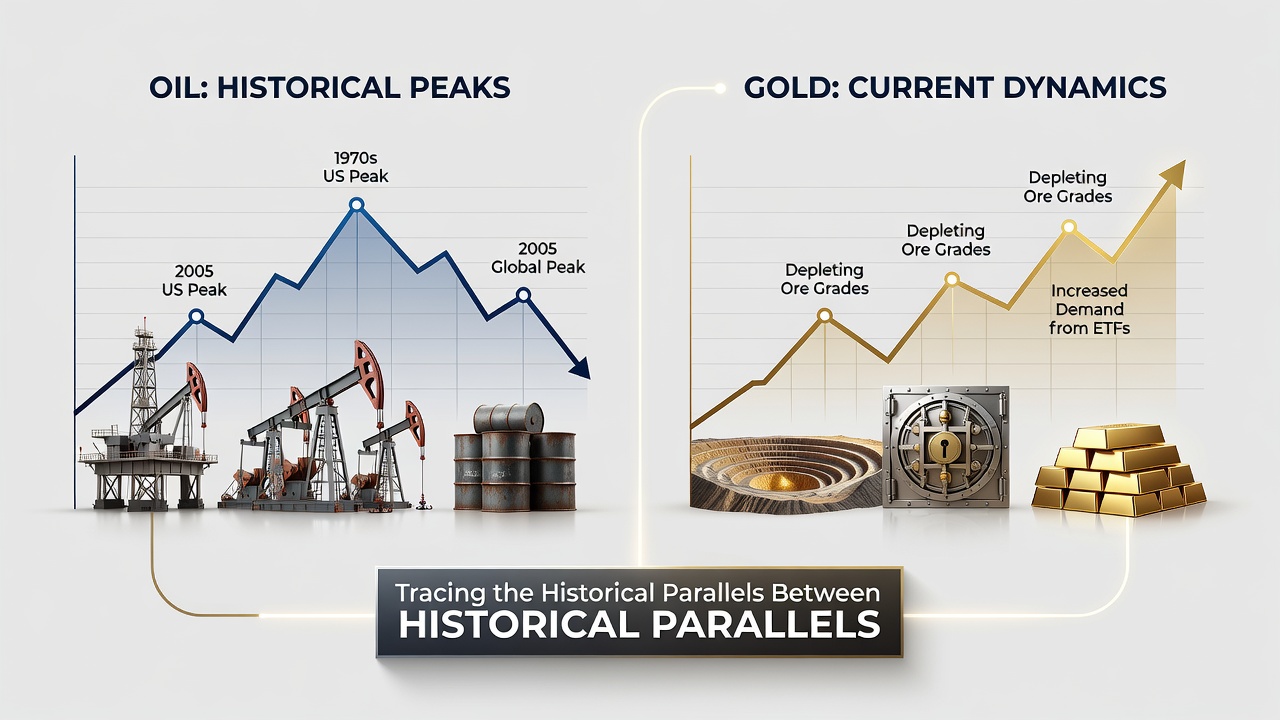
Experts have long examined how oil production followed predictable cycles of growth followed by decline once accessible reserves diminished, and those same patterns now appear in gold mining data where annual output has shown signs of stagnation since the mid-2010s. Researchers at the US Energy Information Administration documented the United States reaching its conventional oil peak around 1970, after which domestic production relied increasingly on unconventional sources such as shale formations that required advanced extraction technologies and higher capital investment. The same principle of reserve depletion applies to gold, where major producing regions including South Africa and Australia have recorded falling ore grades that force companies to process larger volumes of material for smaller quantities of metal. Data from the US Geological Survey indicates global gold mine production hovered near 3,000 metric tons annually in recent years, yet several large operations have entered decline phases similar to those observed in mature oil fields during the 1980s and 1990s. Observers note that both commodities demonstrate how initial discoveries drive rapid output increases, followed by plateaus when easy reserves are exhausted and marginal costs rise sharply. In the oil sector this led to the widespread adoption of enhanced recovery methods and exploration in deeper offshore waters, while gold producers have responded with greater reliance on byproduct recovery from copper and silver mines plus expanded recycling streams that now contribute roughly 25 percent of total supply according to industry reports.Oil Production Cycles and Their Economic Ripple Effects
Hubbert's model predicted that oil production in any given region would follow a bell-shaped curve, and historical records confirm this trajectory played out across multiple basins from Texas to the North Sea. Production from the North Sea peaked in the late 1990s, prompting operators to extend field life through improved drilling techniques while overall regional output gradually fell. Those who've studied these transitions point out that price spikes often accompanied the early stages of decline, as markets adjusted to tightening physical supply before new technologies or sources entered the picture.
Gold supply has followed a comparable path in key districts, with South African output dropping from over 1,000 tons per year in the 1970s to less than 100 tons today as mines reach greater depths and encounter lower concentrations of metal. Canadian and Australian producers have offset some of this reduction through new projects, yet overall growth has slowed markedly, mirroring the way conventional oil growth flattened before shale volumes compensated.
Current Gold Supply Dynamics in a Post-Peak Context
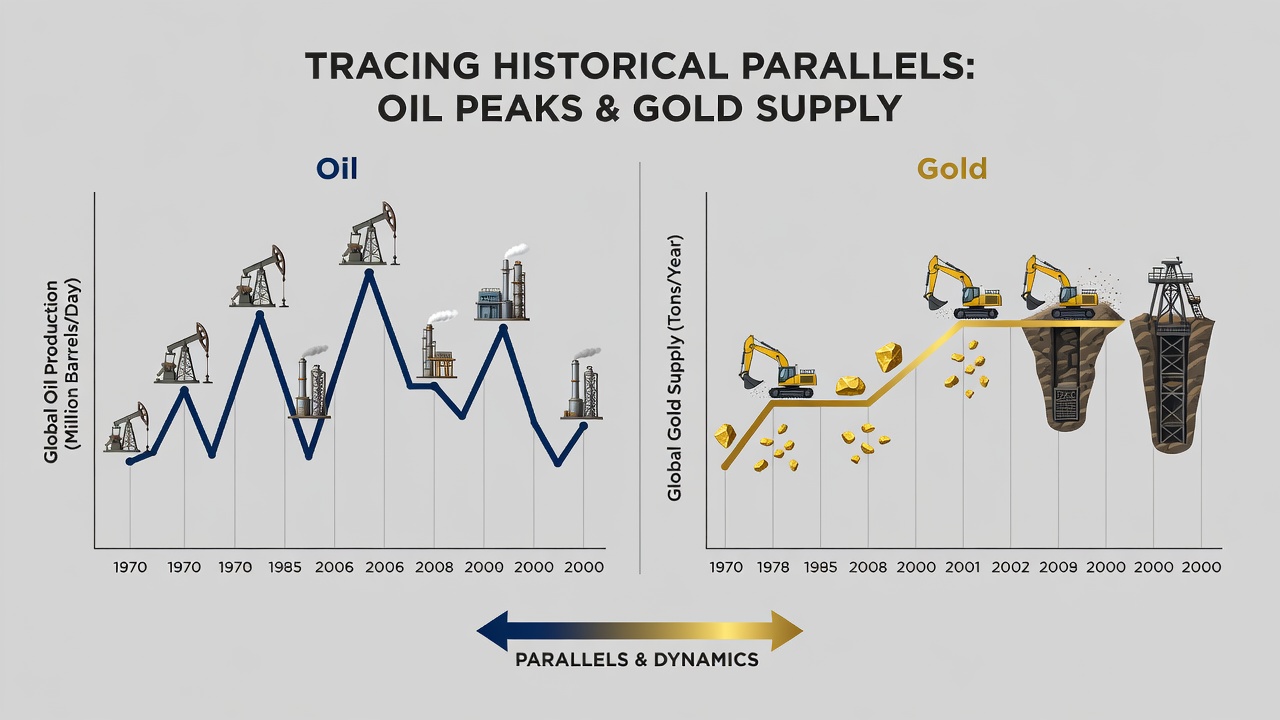
Figures reveal that gold exploration budgets have risen steadily since 2020, yet discoveries of large, high-grade deposits remain infrequent, echoing the increasing difficulty oil companies faced locating giant fields after the 1970s. Recycling from electronic waste and jewelry has grown in importance, much as oil producers turned to enhanced recovery once primary reserves matured.
By September 2026 analysts expect several major gold projects in West Africa and Central Asia to reach full production, yet these additions are projected to only partially offset declines elsewhere, creating a supply profile that resembles the gradual plateau seen in global oil output during the early 2000s. Researchers tracking both sectors highlight how geopolitical factors, regulatory changes, and capital availability influence the timing of new supply responses, although the underlying geological constraints remain consistent across commodities.
Shared Mechanisms Driving Supply Constraints
Declining ore grades in gold parallel the falling productivity of older oil wells, where operators must invest more energy and money to maintain output levels. Studies compiled by Natural Resources Canada show average gold head grades at operating mines have fallen roughly 30 percent over the past two decades, requiring larger-scale operations that carry higher environmental and financial risks.
Oil companies encountered analogous challenges when water cut percentages rose in mature fields, forcing expensive interventions. Both industries have therefore increased focus on technological improvements, including automation, data analytics, and selective mining or drilling methods designed to extract value from lower-quality resources.
Conclusion
The historical record of oil production peaks provides a useful framework for understanding current gold supply trends, where reserve depletion, rising costs, and slower discovery rates shape future output expectations. Data from multiple government agencies and industry sources demonstrate that these parallels arise from fundamental geological and economic realities rather than temporary market conditions. Continued monitoring of production statistics through 2026 and beyond will clarify how closely gold follows the multi-decade trajectory established by oil, particularly as recycling, byproduct recovery, and new project development attempt to balance declining primary mine contributions.