Amir Lehmann · 10 October 2026
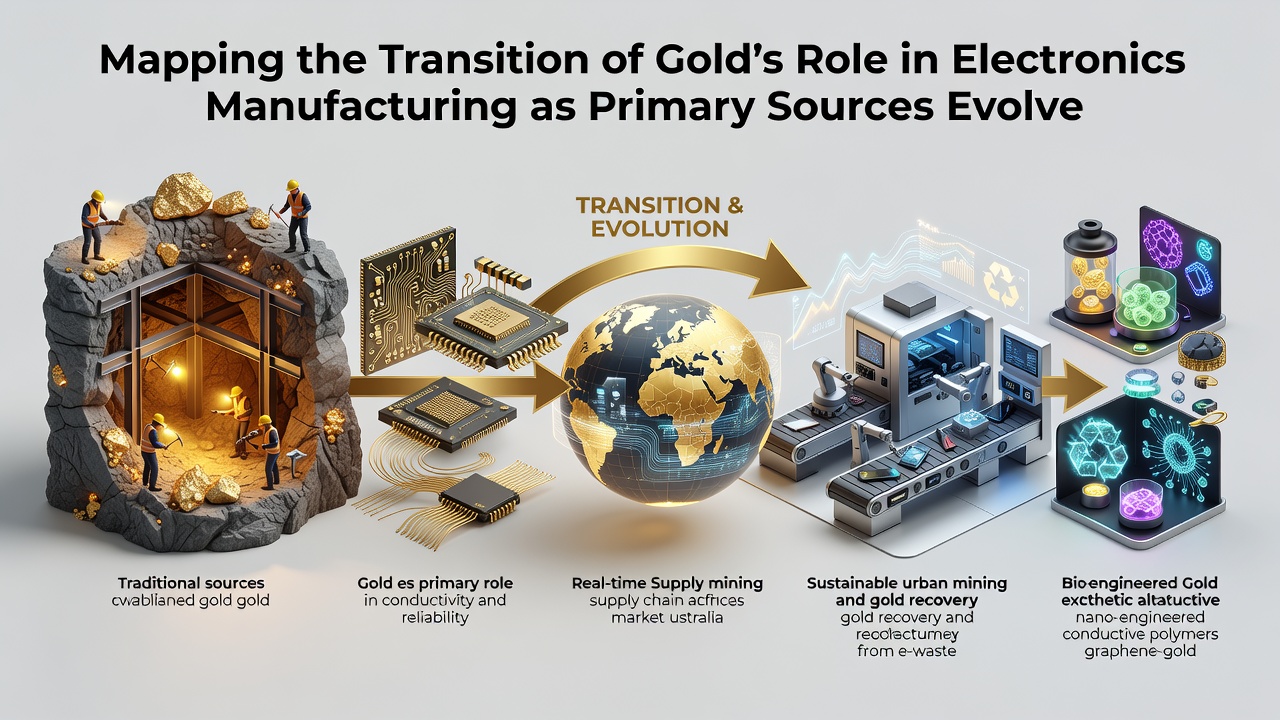
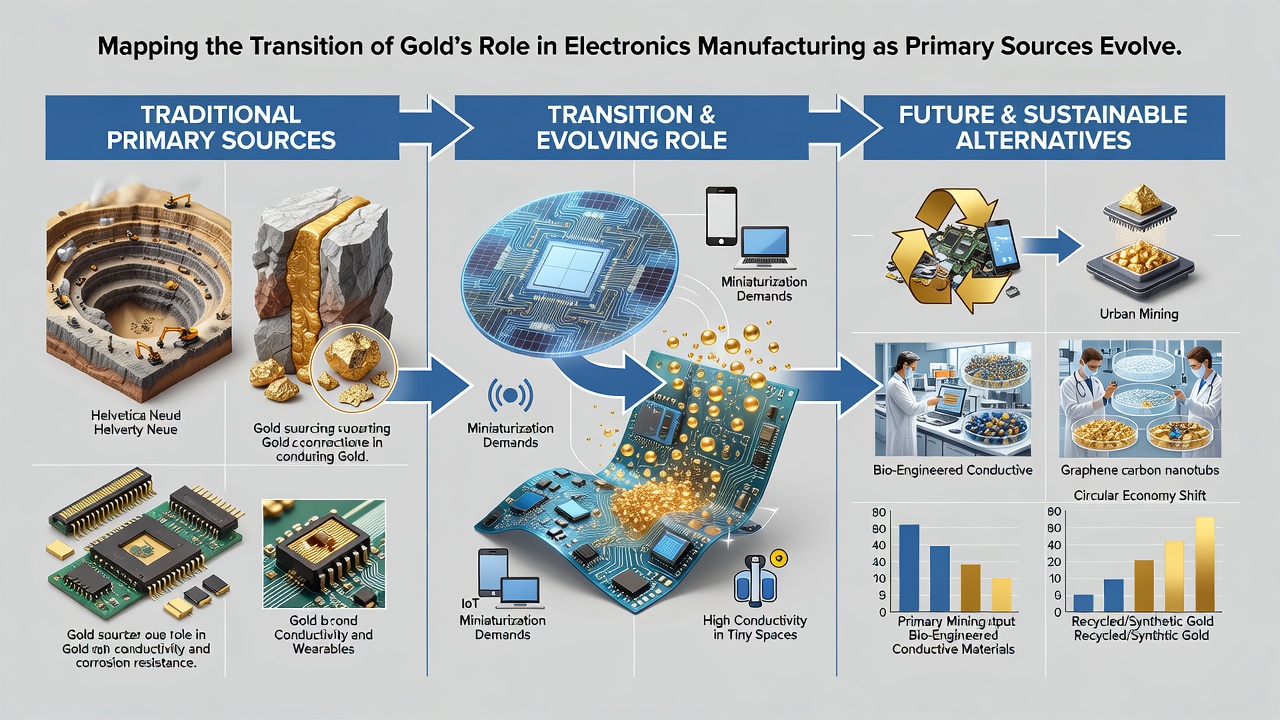
Mapping the Transition of Gold's Role in Electronics Manufacturing as Primary Sources Evolve
Gold's Established Place in Electronics Production
Electronics manufacturers rely on gold for its superior electrical conductivity and resistance to corrosion in components such as connectors, printed circuit boards, and semiconductor bonding wires, where even thin layers maintain performance across high-reliability applications in automotive systems, medical devices, and consumer gadgets. Data from industry reports indicate that electronics account for roughly 8 to 10 percent of global gold demand annually, with consumption patterns tied directly to production volumes of smartphones, computers, and servers that incorporate gold in contact points to prevent oxidation over time.
Researchers at materials science institutions have documented how primary gold supply from traditional mining operations has faced constraints due to declining ore grades and extended permitting timelines in major producing regions, prompting manufacturers to track evolving sources that include recycled material from end-of-life electronics. Figures from the US Geological Survey reveal that mine production has stabilized while secondary recovery rates have increased steadily through collection programs in North America and Europe.
Shifts in Primary Supply Sources
Primary sources for gold in electronics now encompass not only newly mined output but also refined secondary streams from urban mining initiatives that extract gold from discarded circuit boards and connectors, a process that experts note recovers up to 95 percent of the metal when facilities use advanced hydrometallurgical techniques. In October 2026, supply chain analyses presented at industry forums highlighted how regulatory frameworks in Canada and Australia have accelerated investment in recycling infrastructure, reducing dependence on virgin material from South African and Russian mines where geopolitical factors have influenced export volumes.
Those who monitor commodity flows observe that electronics firms have adjusted procurement strategies to blend mined and recycled gold, with traceability systems ensuring compliance with conflict mineral regulations enforced by authorities in the United States and the European Union. Studies from academic research groups show that recycled gold now supplies approximately 20 percent of electronics sector needs, a proportion that continues to rise as collection networks expand in Asia and Latin America.
Manufacturing Adaptations and Material Efficiency
Manufacturers have responded to source transitions by optimizing gold deposition processes, applying thinner coatings through electroplating advancements that maintain functionality while lowering overall consumption per device. Evidence from trade association data indicates that substitution efforts with palladium or copper alloys occur selectively in low-current applications, yet gold remains essential for high-frequency and high-reliability circuits where alternatives introduce performance trade-offs.
One case tracked by supply chain analysts involved a major semiconductor producer that integrated closed-loop recycling partnerships with refiners in Japan and Germany, recovering gold from production scrap and returning it directly to component fabrication lines. This approach aligns with broader patterns where companies monitor primary source evolution through contracts that specify recycled content percentages, supported by verification protocols from international standards bodies.
Regional Variations in Source Evolution
Supply dynamics differ across regions, with European electronics assemblers drawing more heavily from certified recycled streams due to circular economy directives, whereas facilities in East Asia continue sourcing a larger share from regional mines alongside imported refined material. Government statistics compiled by Australian authorities document how domestic recycling capacity has grown to offset fluctuations in global mine output, providing stable feedstock for local manufacturers of high-end connectors and sensors.
Observers note that price volatility in primary gold markets influences these transitions, as electronics buyers hedge through long-term agreements with refiners that process both mined and scrap inputs. Research published in materials journals confirms that the purity requirements for electronics-grade gold, typically 99.99 percent or higher, remain consistent regardless of whether the metal originates from ore or recovered components.
Outlook for Continued Transition
Projections based on current extraction and recovery trends suggest that secondary sources will constitute an increasing share of gold supply for electronics through the remainder of the decade, driven by improvements in collection logistics and refining efficiency. Industry reports from organizations tracking critical materials indicate that ongoing developments in bioleaching and solvent extraction methods further support this shift by lowering energy inputs compared with traditional mining operations.
Conclusion
The transition of gold's role in electronics manufacturing reflects measurable changes in primary source composition, where recycled streams complement and gradually expand relative to mined production. Data from multiple government agencies and research entities show that manufacturers maintain performance standards while adapting procurement to these evolving supplies, ensuring continuity in component reliability across global production networks.